
Kensington Place
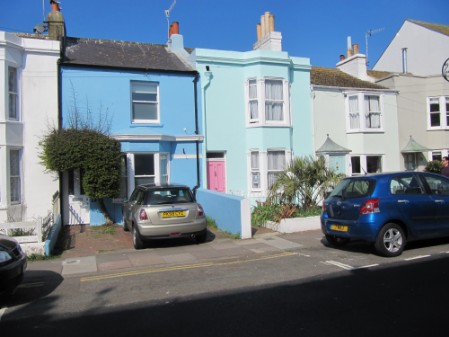
The western side of Kensington Place
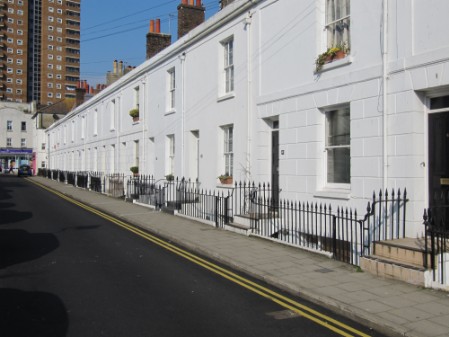
The eastern side of Kensington Place
Houses as early as the 1820s
Houses
first began to appear in Kensington Place in the 1820s. A glance at
J.Pigot.Smith’s 1826 map of Brighton shows a number of houses on the west side
of the street. The
land for Nos 28,29 was bought by Michael Smith from John Field in 1830. Smith,
a builder, built two houses and then took up residence with his family. By
1877, Smith was able to buy the freehold of the property jointly with his
neighbour, William Wood, who bought the freehold to No 28.
The eastern side bought for £950
The
cottages on the western side were built in the 1820s whilst the land on the
eastern side was acquired in 1846 by Henry Schilling for £950. Schilling had
been born in Jena, Germany and subsequently migrated to England where he
settled in Brighton where he developed a mineral water factory in Middle
Street. Within a year of buying the land he was selling on plots of land for
£70 a plot.
The
residents of the street have generally been skilled artisans. The 1851 census
refers to drapers, beer shop keepers, tailors, bootmakers, printsellers,
cabinet makers, laundresses, general servants whilst the 1883 census makes
reference to the Hearts of Oak beer house at no. 17 and a lodging house at no.
8. The street has always had its share of teachers with the 1900 census
mentioning a teacher of music at no. 31 and a day school at no 34.
The home of Peggy Ramsey
The
link with culture and education at no. 34 was to last into the 20th Century for
this was the home of the famous West End literary agent, Peggy Ramsey, who had
a weekend home in the street from the 1960’s. Peggy was to be made famous in
the 1987 Alan Bennett-scripted film ‘Prick Up Your Ears’, about the life and
death of the playwright Joe Orton. It was Peggy who discovered the talent of
Joe Orton and then helped him in his career before finally identifying his
battered body in 1967.
Peggy would spend many a weekend in Kensington Place, leaving London at 4pm on Fridays to travel down by train. She did not involve herself in the literary scene in the town (not liking one of the town’s leading lights of the time-Laurence Olivier) but instead busied herself around the streets of the North Laine.

A nicve old house in a back street
he must have enjoyed the bric-a-brac shops of the area, (they still give a particular charm to the area) for her house was reputedly filled with what Joe Orton described as clutter. In his diary entry for 29th July, 1967, he says ‘‘We went to Peggy’s house....’her little place’. It was a nice old house in a back street. Built mid-nineteenth century. Peggy had it filled with bric-a brac. All of it interesting but really there was too much¼.She took me downstairs and showed me the garden¼I liked the garden. Cluttered gardens are fun. Cluttered houses I’m not fond of.’’ Two weeks later Joe Orton was to die.
Behind
Kensington Place there is a little lane, Trafalgar Lane, where Peggy had bought
a small cottage (which she called her hut) which she let her clients use. David
Hare write most of ‘Licking Hitler’ here as well as ‘A Map Of The World’.
Having no telephone and being so close to London was ideal for writers.
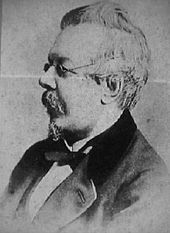
William Moon
Other
notable residents of the street include William Moon, who published books for
the blind and was Master of a Blind School in Church St. Moon lived for a short
time at no 44 Kensington Place. Robert
Shelton also lived in the street for a time in the 1980s. Shelton was a music
critic whose claim to fame was that his review of a Dylan gig in Greenwich
village led to his getting a recording contract to record 'Blowing in the
Wind'.
Kensington
Place continues today to be one of Brighton’s most attractive residential
streets. It has been chosen as the set for TV dramas (in 1980 the street was
used as the set for a TV serial ‘ A Little Silver Trumpet’) and it now has a
number of houses(on the eastern side ) that have been given grade II listed
status by the Department for Culture, Media and Sport.