The Military in North Laine part 1
1795-1914
For over 150 years, from the 1790s to the
1940s, North Laine had strong links with the military, being home to army
bases, providing men for war and in the Second World War being the target for
German bombs. Clues to this military past can still be seen and contribute to
the area's Victorian townscape.
Military tented camps and semi-permanent
barracks
In 1793 France declared war on Britain and
speculation about a possible invasion led to the establishment of temporary
military tented camps all along the south coast. The transformation of Brighton
into a resort by 1780, and the popularity of the town among the aristocracy and
the officer class of the army, made the town a strategic base for Britain's
defences. As North Laine lay close to the town and land was relatively
cheap, a number of sites were chosen for semi-permanent barracks, as
housing for soldiers.
Windsor Street barracks
One site chosen was in Windsor Street (where
Boots is now). These barracks, next to the stables in the yard behind the
Unicorn Inn, were in an area built around an overflowing cesspool. A little
north of the Windsor Street barracks (the site of the present day Brighthelm
Centre), the army built a hospital located near to the town's overflowing
cemetery and amongst a series of stables and close to a hog pound and a
slaughterhouse. Both barracks remained until around 1815 when Napoleon was
defeated at Waterloo.

Marchant's 1808 map showing the infantry barracks
Barracks in Church Street
Lasting longer than these barracks were the barracks built at the bottom of Church Street. Constructed in 1796 and known as Church Street or Pavilion Barracks, this military facility remained until demolition in 1869, by which time they had become an eyesore.
They consisted of buildings which included timber huts on a brick base used as accommodation for the soldiers together with stables, store rooms, offices, a guard house and a wash and cook house. These barracks occupied a site that stretched
from the entrance in Church Street to North Road. At the height of the
Napoleonic Wars the barracks provided accommodation for over 600 infantry. A
posting to the barracks was not sought after as conditions were quite grim with
severe overcrowding (two to a bed) and little maintenance of the site.
Atrocious conditions for soldiers
The soldiers in the various North Laine
barracks lived in atrocious conditions. As the Napoleonic wars dragged on, they
were kept in the barracks with little to do apart from the occasional military
exercise. Soldiers became depressed and there were cases of suicide, bullying,
frequent fighting and sometimes murder. What did provide some diversion for
those in the Church St barracks were visits to the nearby King and Queen inn,
which could be reached through a little hole made in the perimeter wall of the
barracks compound.
Church Street barracks used for the Prince
Regent's guard
After 1815 the Church Street barracks provided
accommodation for the Prince Regent's guard while he was staying at the Royal
Pavilion. After 1830 though the barracks were little used as William IV and
then Victoria visited the town infrequently. With little use and no maintenance
the Church Street barracks deteriorated, although from 1859 the Brighton Corps
of the Sussex Volunteer Artillery used part of the site as a depot and training
area.

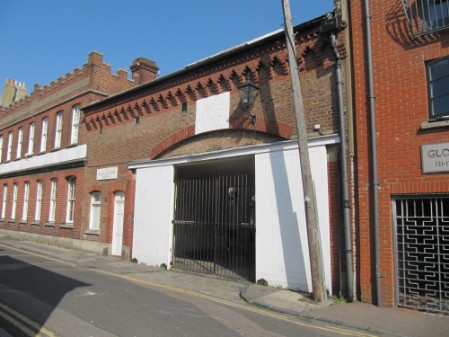
The drill hall in Gloucester Rd, bought and fitted out at the expense of Charles Smith Hannington
Voluntary military units formed
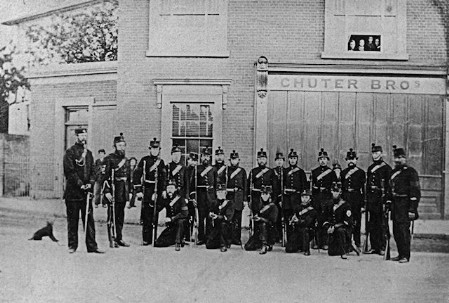
The Brighton Corps of the Sussex Volunteer Artillery, together with the Brighton Corps of the Sussex Volunteer Rifles, were formed in 1859 following the threat of war with France and voluntary military units formed all over the country to provide an additional defensive force.
The volunteers first used the Church Street barracks
The artillery volunteers when first formed drilled at the Town Hall but they soon got permission to use a corner of the disused Church Street barracks. Having a more permanent base encouraged more people to join, including 60 employees of the Palmer and Green foundry in North Road, which must have included many residents of North Laine. Commander of the artillery volunteers in the late 1860s was Charles Smith Hannington (of the department store), and it was he who in 1869 informed the volunteers that he had acquired the former Eagle Foundry in Gloucester Road and that he was refurbishing it to accommodate the Corps. The Church Street barracks were demolished and the only clue to their former existence is a sign 'Barrack Yard' at the bottom of North Road.Military features on the building
The former foundry was rebuilt with military features and although the building has now been converted to flats the castellated roofline and a flagpole can still be seen. Inside the building was an officers' mess and rest rooms and there were similar facilities for the sergeants and non-commissioned officers (NCOs), as well as two halls for training with the guns. Initially the men had to train with a wooden gun but at their Gloucester Road depot the men had four field guns to practise with.
Tamplin provided a new drill hall
The Brighton Corps of Rifle Volunteers was also based at the Town Hall, where most of their drills were held until the late 1880s. Under Lieutenant Colonel Tamplin (of the brewing family) the corps expanded to 724 men, becoming the First Volunteer battalion of the Royal Sussex Regiment, and it was Tamplin who provided the rifle volunteers with a permanent base when he used his wealth from his brewery to construct a brand new purpose built drill hall at the top of Church Street. This was completed in 1890 and contained excellent facilities for the officers, sergeants and men.


Volunteers saw active service in the Second Anglo-Boer War
In 1900 volunteers from the Brighton Corps of Rifles were among the first volunteers to see active service when they served in the First Battalion of the Royal Sussex Regiment in the Second Anglo-
The Hove volunteers who fought in the Boer War
Annual mock battles in Brighton
Once a year between 1860 and 1872, civilian
volunteers from all over the country came to Brighton at Easter for parades and
mock battles on the downs around the town. The Brighton volunteers had the job
of organising the routes by which the volunteers arriving in Brighton would get
to the site of the parade and the military exercise. There could be up to
19,000 volunteers taking part in these mock battles and it was a colossal task
to get them and their families to the appropriate locations.
Routed through the narrow streets of North
Laine
Volunteers came by special trains with up to 22
passenger carriages and special trucks fitted out for the horses. On arrival in
Brighton the men would be routed through the narrow streets of North Laine.
This would be quite a spectacle for local residents, who turned out to see the
sight of thousands of soldiers dressed in different uniforms. The Level or the
grounds around St Peter's Church were often used as a meeting point and
volunteers were routed down Trafalgar Street or Gloucester Road. Some of the
volunteers assembled on the parade ground of the Church Street barracks and these
were sent down Queen's Road and then Church Street. In later years the station
goods yard was used for disembarkation from the trains and then most of the
volunteers used Trafalgar Street to get to their meeting point. On the stroke
of 11am a gun would go off from Pavilion Gardens signalling the beginning of
the march to the site of the mock battle. Crowds thronged the route and
families of the soldiers followed to witness the spectacle and enjoy the side
attractions.

Volunteers mustering on The Level, 1865
For The military in North Laine part 2, 1914-1945 click here

Volunteers on Brighton beach 1866
Related Pages